More young people search Instagram for local businesses than Google. SOCi surveyed 1,002 Americans aged 18 to 24 in 2024, and 67% used Instagram to find local businesses, ahead of TikTok at 62% and Google at 61%. An account built only for scrolling is invisible in the place those customers are looking.
Instagram SEO needs no tools and no budget. It is filling in the fields Instagram already gives you, in the words searchers type. Here are the fields and what goes in each.
Where Instagram search shows results
Type a trade into Instagram's search bar and the results arrive in layers: accounts, places, Reels, recent posts. Your account competes in the accounts row through its name field and bio. Your posts compete in the post and Reel layers through captions, alt text and what you say out loud, because Instagram transcribes Reels speech the way TikTok does.
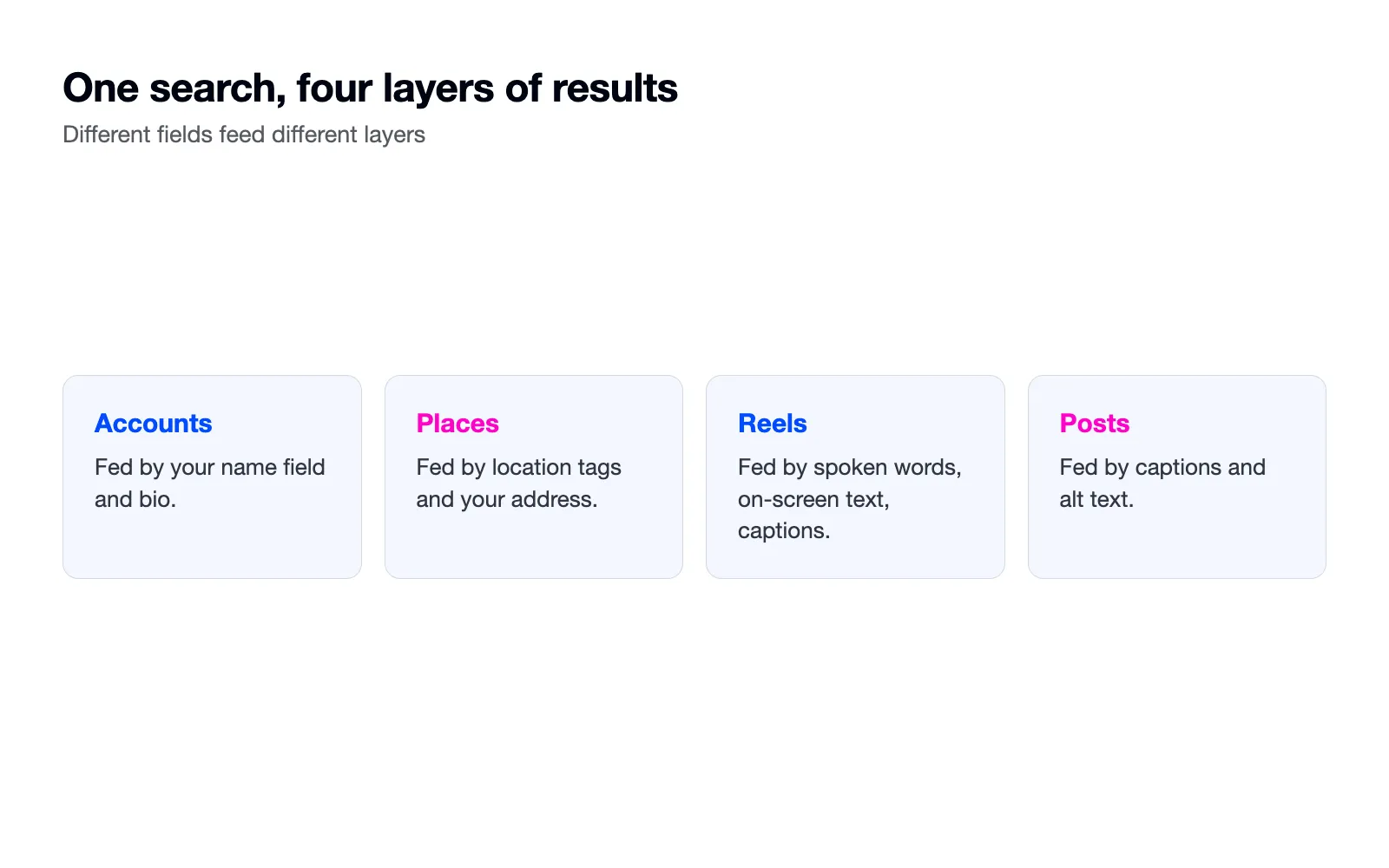
That layering is why the fields below matter separately. A perfect bio with empty captions wins the account row and loses every post search, and the post searches are where the daily traffic is.
The name field is a search field
Your profile has a handle and a name, and they are different fields. The handle is your address and can stay clean: rosasbakes. The name field is searchable text, and it takes more than a name: Rosa's, Bakery, Leeds. An account with the trade and the town in the name field appears in searches for them. An account with only a name appears in searches for the name, which customers who have not met you will never type.
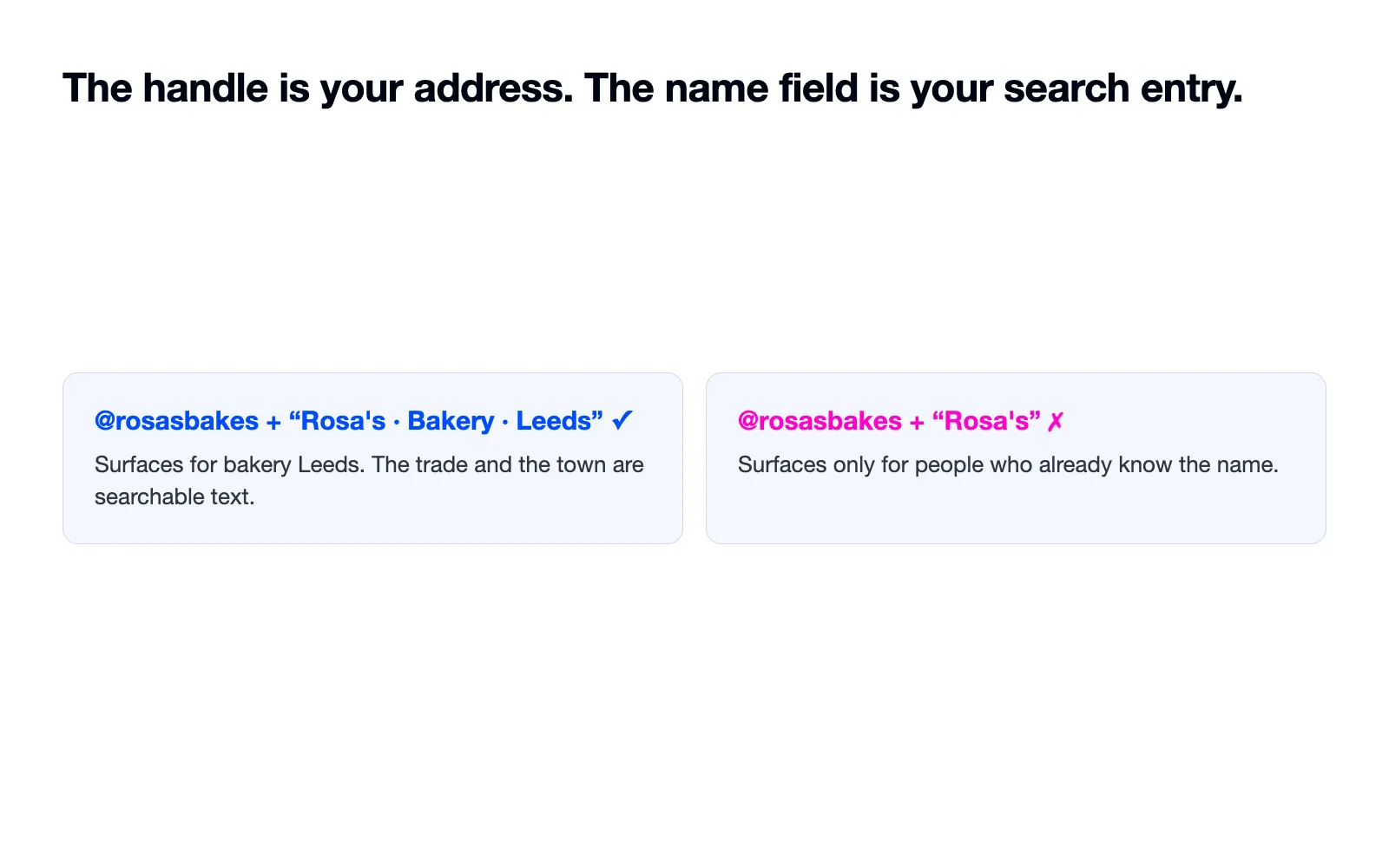
The name field takes about thirty characters, so it holds three things at most: the name, the trade, the town. If the three do not fit, keep the name and the trade, and let the bio carry the town.
A bio in the words people type
The first line of the bio does the searching work: what you do and where, plainly. Wedding cakes and weekend bakes in Leeds. A bio that leads with handcrafted moments of joy does not surface for wedding cakes Leeds, because search matches words, and nobody searches for moments.
Keep the poetry if you want it, but put it after the plain line, not instead of it. The bio has room for both, and only one of them is doing a job.
Write captions search can read
Instagram search reads caption text and surfaces matching posts. A caption written as a sentence with topic words in it makes the post findable for as long as the post exists. A caption that is one emoji makes it findable never.
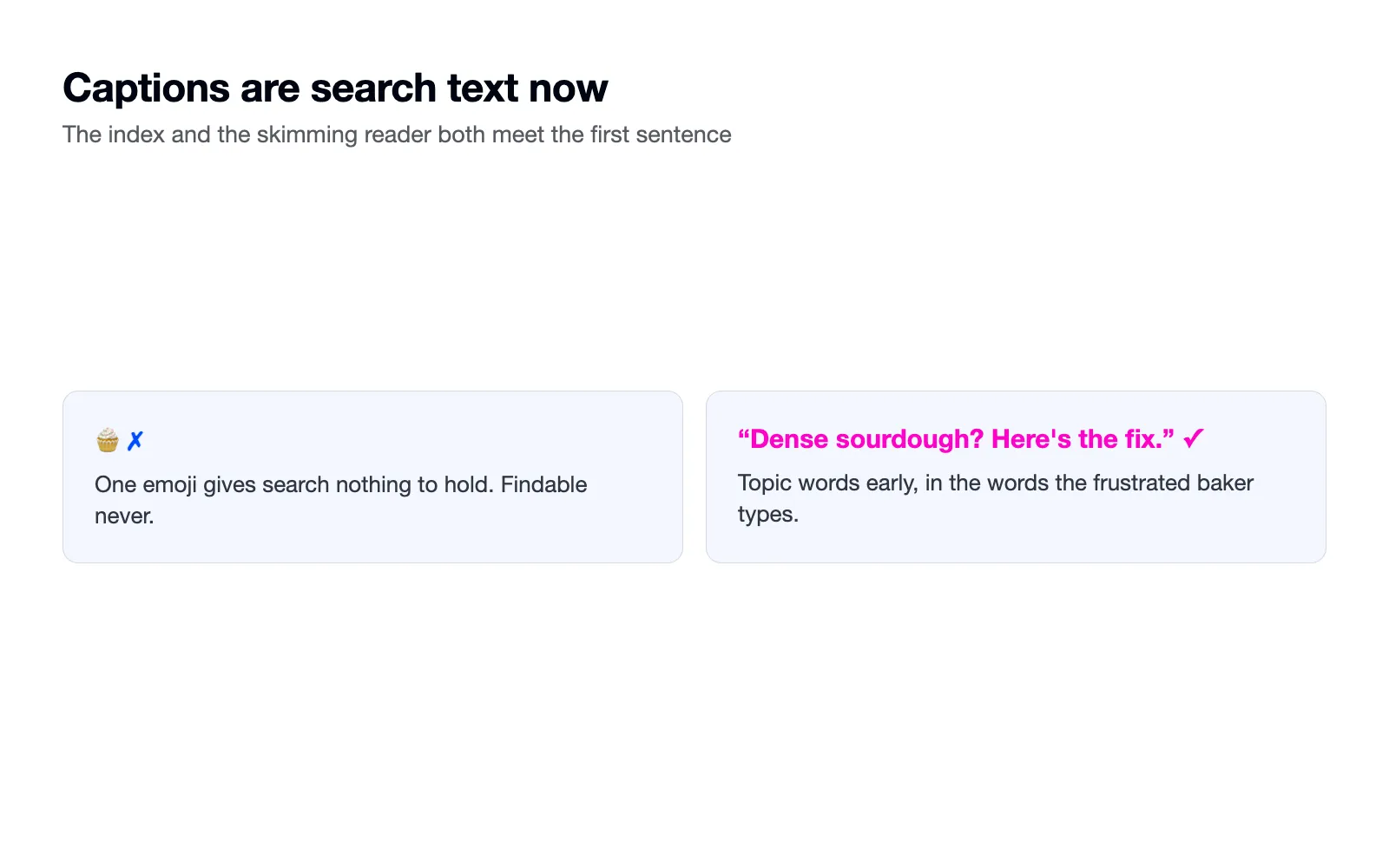
Put the topic words in the first sentence. Captions truncate in most views, and the search index and the skimming reader both meet the opening first. A post about fixing dense sourdough should say dense sourdough early, in those words, because those are the words the frustrated baker types.
Hashtags do the same filing job here as on TikTok: three to five that name the topic, the trade and the town. Instagram's own guidance treats hashtags as categorisation, and thirty hopeful tags file the post as nothing in particular.
Alt text, the field almost nobody fills
Every Instagram post has an alt text field, under advanced settings when you post and editable afterwards. It exists for people using screen readers, and the search index reads it too. Both audiences want the same sentence: what the image shows, plainly. Three-tier sponge with white icing and dried flowers, on the counter at Rosa's.
Write it in the posting flow and it takes twenty seconds. Filling it on your last twenty posts takes one sitting, and afterwards every image on the account is legible to a reader who cannot see it and an index that never could.
Do not stuff it. Alt text listing ten services reads as spam to the index and as noise to the screen reader, and both were the audience.
Fix the posts you already made
The index already holds your old posts, which makes them editable search entries. Take your twenty best posts, rewrite their captions with topic words in the first sentence, and fill the empty alt text on each. The engagement those posts earned stays attached, so an old post with a fixed caption often surfaces faster than a new one.
Do not delete and repost while you are in there. A reposted photo starts from zero, and the original's history is what search was counting.
Tag the place
Location tags feed local search directly. Tag the town or the venue on posts and stories, and keep the address filled in on a business profile so the account surfaces on the map. For a business that serves one town, the location tag quietly qualifies every post for the searches that end in a visit.
If you have a shop, keep the address and hours current wherever they appear. A searcher who finds you and then finds last year's hours converts the visit into a wasted trip and remembers it.
Keywords you already own
Your inbox is a keyword list. Customers type what they want in their own words, and those words are the queries: do you do gluten free, how much is a birthday cake, are you open bank holiday. Save them in a running note, and spend them in captions and answer posts.
What decides the ranking
Matching the words gets you into the results. Engagement decides where you sit in them: saves, sends and watch time, the same signals that rank everything else on the platform. The fields in this guide get the searcher to your post. The post has to be good enough to keep its position, which is the half our other guides cover.
For the words themselves, use Instagram's own search bar the way our TikTok guide uses TikTok's: type the root of your trade and note what autocomplete offers. Those suggestions are real searches in real wording, and they belong in your name field, your bio line and your captions.
Saves and sends are also the honest measure of whether a search-facing post did its job, since a searcher who saves your post has filed you for the moment they are ready to buy.
What to skip
Skip anything sold as Instagram SEO services, guaranteed rankings or follower growth. Search here runs on filled fields and engagement, both of which you control for free, and paid shortcuts on either tend to end in spam or a ban.
Skip keyword stuffing too. A bio or caption that reads as a keyword list repels the humans it was written to catch, and the platform reads it as spam. One plain sentence with the words in it does the job.
Check what you rank for
Search your trade and your town from an account that is not yours, or a friend's phone. Note who surfaces and read their fields: name, bio line, captions. The gap between their fields and yours is your task list, and most of it is an hour of typing.
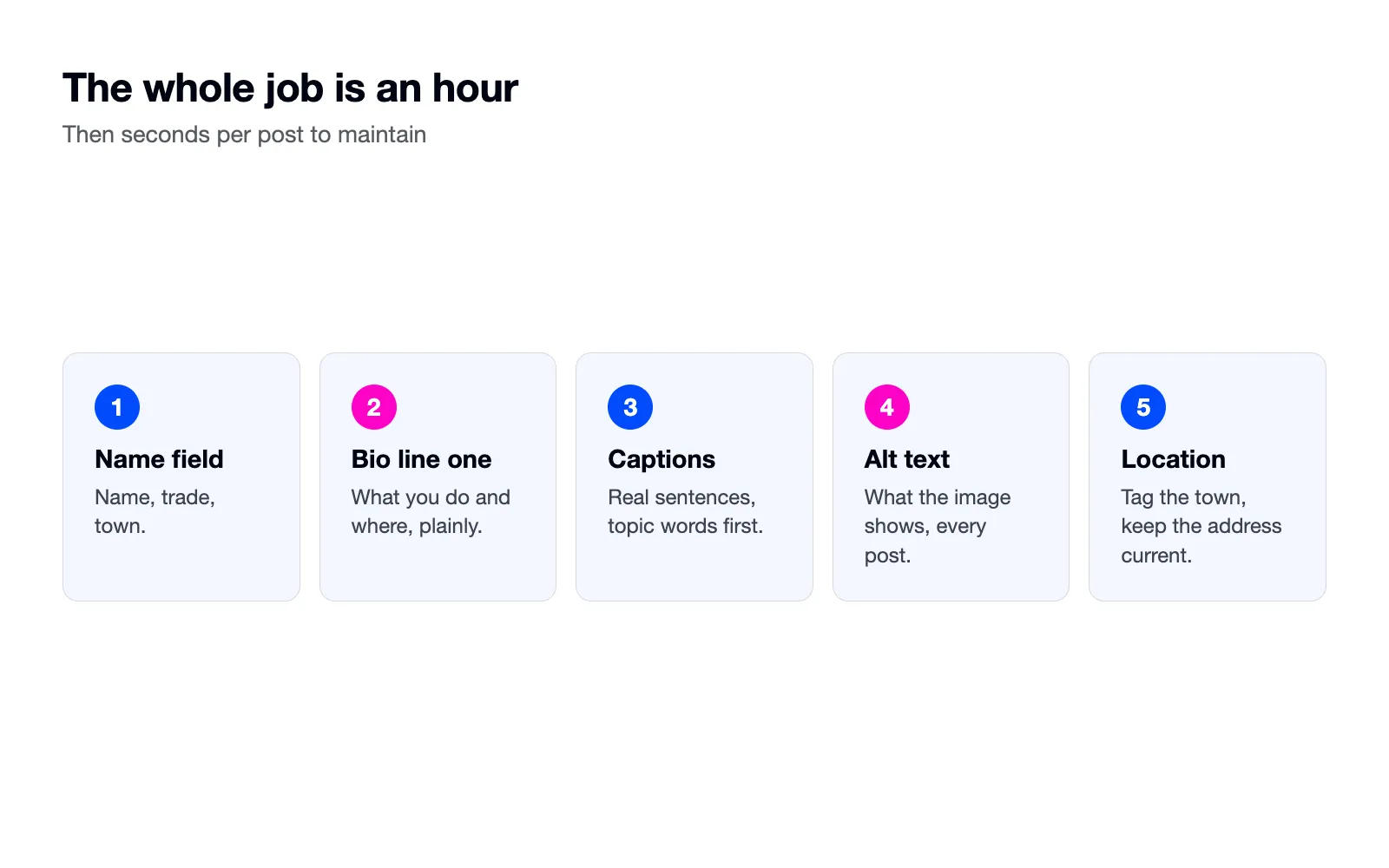
That is the whole job. Name field, bio line, caption habit, alt text habit, location tags. An hour to set up, seconds per post to maintain, and every post afterwards is another page in the index, findable by the next person who types what you sell.

Georgia May
CEO & Founder of Tea & Toast