HubSpot's State of Marketing 2026 found 94% of marketers plan to use AI for content this year, and their AI trends data puts the saving around six hours a week. There is a downside: feeds are filling with captions that all sound alike, and readers have learned the tells. Text that reads mass-produced now performs like it.
So the useful question is not whether to use AI. It is which jobs to give it. Our rule, for clients and for ourselves: AI drafts, a human publishes. Everything below is that rule in practice.
The jobs AI is good at
AI is good at two jobs: producing options in bulk, and converting content between formats. Turning one video transcript into a caption, a LinkedIn post, and an email paragraph. Producing twenty first-line options so you can pick one. Reshaping a caption to five platform lengths. Summarizing a hundred comments into the five questions your audience keeps asking. These jobs are mechanical, the output gets rewritten anyway, and the hours saved are real.
The jobs to keep are the ones with your name on them. Anything stating a fact or a number, because AI invents both with total confidence. Replies to actual humans, because people can tell. And your voice itself: AI can imitate it from examples, but it cannot originate it, and every unedited AI caption you publish trains your audience to skim you.
Prompts that do the work
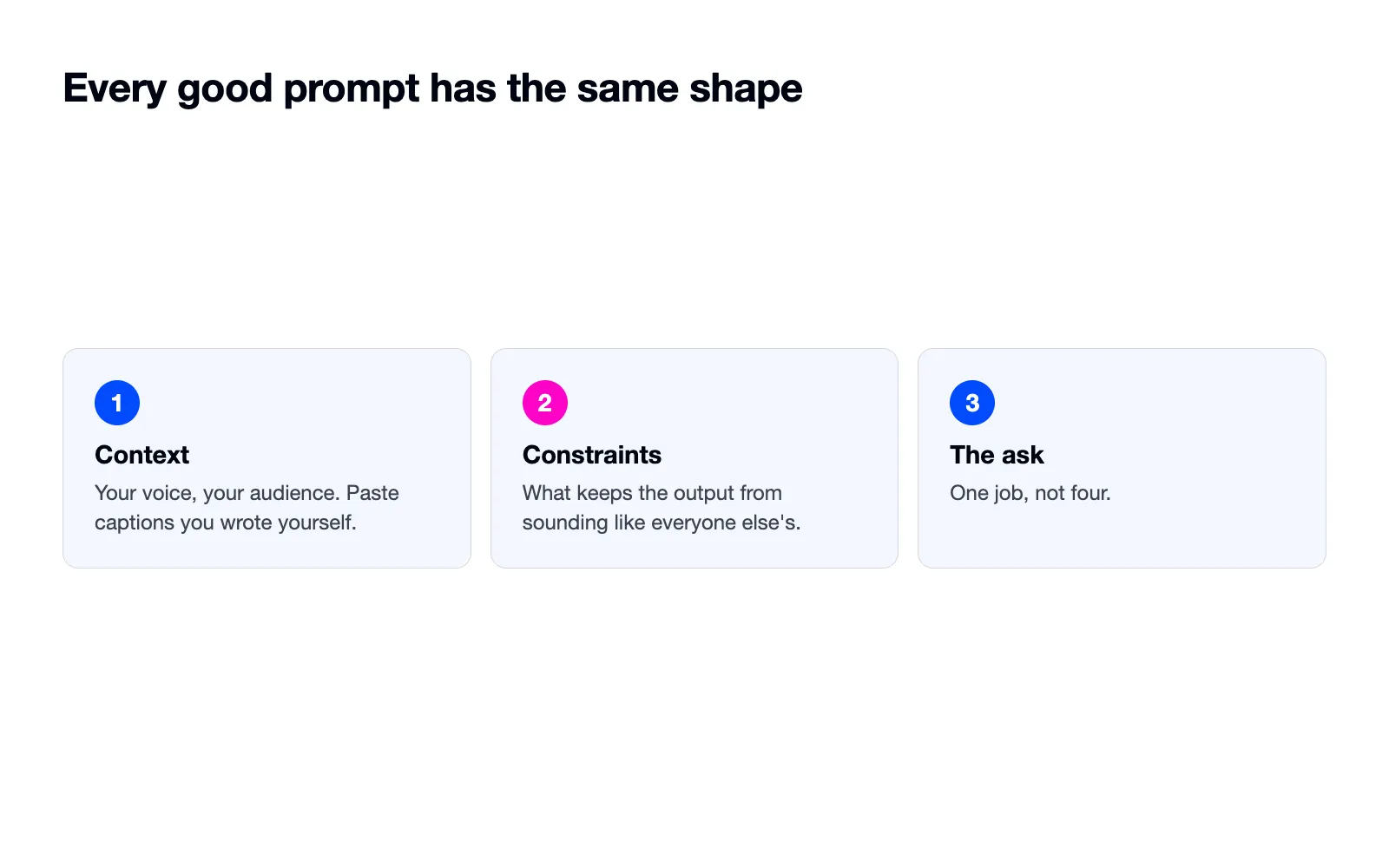
Every good prompt here has the same shape: context first, constraints second, the ask last. The context is your voice and your audience. The constraints are what keep the output from sounding like everyone else's. The ask is one job, not four.
The voice sample prompt. Paste six captions you wrote yourself and are proud of, then: 'These are captions we wrote for our own account. Describe the voice in three plain sentences, then write 10 caption options for [topic] in that voice.' The description step forces the model to notice the voice before imitating it, and the difference shows.
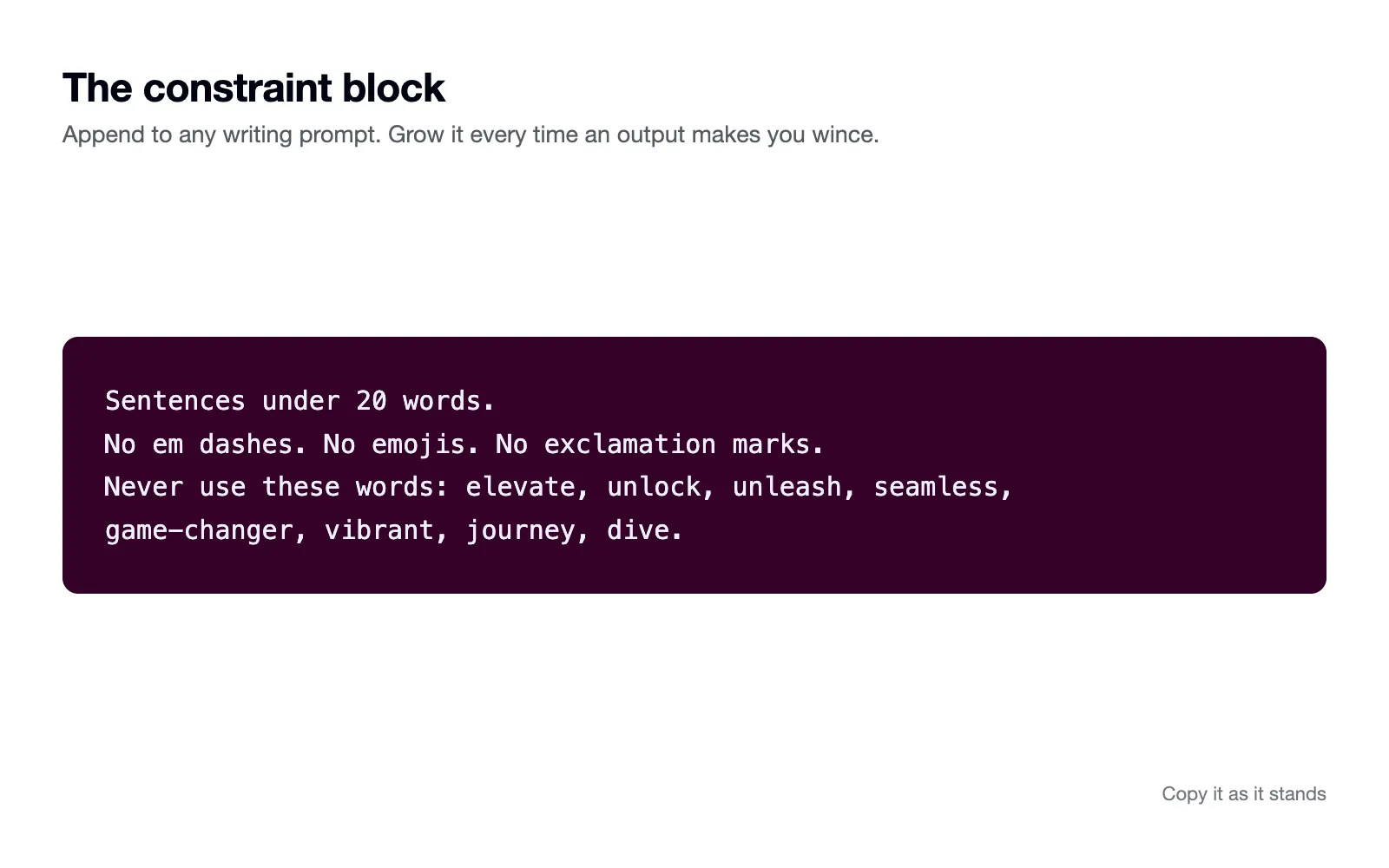
The constraint block. Append this to any writing prompt: 'Sentences under 20 words. No em dashes. No emojis. No exclamation marks. Never use these words: elevate, unlock, unleash, seamless, game-changer, vibrant, journey, dive.' Every item bans a known tell. Keep the list somewhere handy and grow it every time an output makes you wince.
The options prompt. 'Write 10 different first lines for a post about [topic]. Make them genuinely different from each other: a question, a number, a flat statement, a customer's words.' You are not asking for a caption. You are asking for raw material, and you will rewrite the one you pick.
The repurpose prompt. 'Here is the transcript of a 60-second video. Write a 100-word caption for Instagram and a 3-sentence version for LinkedIn. Use only facts that appear in the transcript.' That last sentence is the one that matters. It stops the model from adding facts you never gave it.
The comment-mining prompt. Paste a month of comments and DMs, then: 'List the questions that appear more than once, in the customers' own words.' The output is next month's content plan, sourced from the people who will watch it. Answering a question your audience demonstrably asks beats guessing what they might want.
The cut prompt. Paste your own draft and ask: 'Cut this by a third without losing any facts.' AI is a mediocre writer and an excellent trimmer. You write the draft, it cuts, you do the final read.
A month of ideas in one prompt
Planning is the safest place to use AI heavily, because no generated text reaches the public. Give the model your real structure: 'We post three times a week: one post answering a customer question, one showing the work, one human moment. We are a [business] in [town]. Draft a four-week grid of ideas, one line each.' You will veto half of it, and the surviving half arrives faster than a blank page ever fills.
Treat the grid as a draft calendar, not a commitment. Swap the weak ideas, slot in what actually happened that week, and keep the gaps for reacting. The model supplies a starting grid. Real weeks supply the rest.
The giveaway phrases to strip
Before anything ships, sweep for the tells. Elevate, unlock, unleash, game-changer. In today's fast-paced world. Look no further. Let's dive in. The it's-not-just-this-it's-that construction. Chains of em dashes. A rocket emoji on a post about scones. We're thrilled to announce, attached to something nobody would announce.
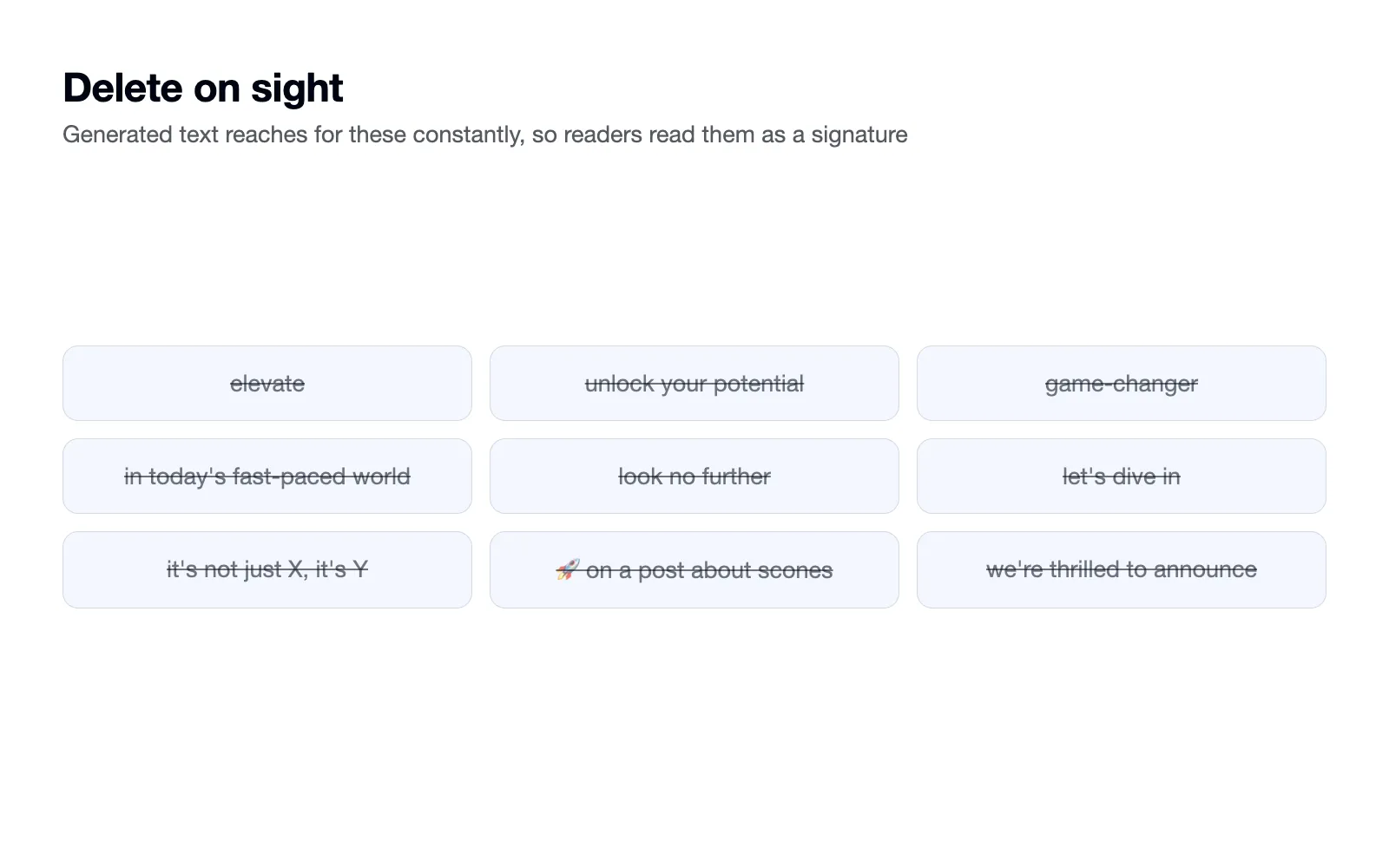
None of these words are wrong on their own. The problem is that generated text reaches for them constantly, so readers now read them as a signature. Delete on sight and say the plain thing instead. Announcing less and stating more is most of what sounding human means.
Where we draw the line
Text is draftable. Imagery is not. We do not publish AI-generated images on our channels or our clients', full stop. Audiences clock synthetic images faster than synthetic text, the uncanny hands and the too-smooth light, and one spotted fake undoes trust that real photos built over months. A phone photo of your actual shop beats a flawless render of a shop that does not exist.
Numbers get the same treatment. Any statistic in a caption gets checked by a person against the source before it ships, because models state wrong figures with the same confidence as right ones. The tool drafts the sentence. It does not get to vouch for it.
Disclosure has a simple line too. Nobody expects a caption to declare that a tool helped draft it, any more than they expect a spellcheck credit. The line is deception about real things: reviews no customer wrote, photos of products that do not exist, testimonials from nobody. Using a tool to draft is normal. Fabricated evidence is fraud, whatever wrote it.
If a client ever asks us for the fake version, the answer is the same arithmetic as everywhere else in this guide. Trust builds slower than reach and dies faster, and one caught fabrication costs more than a year of honest captions earned.
Read it aloud before it ships
Read the final text aloud, once, before it ships. If a sentence is not something you would say to a customer across the counter, rewrite it in the words you would actually use. Reading aloud catches what silent reading misses.
Then add one detail the model could not know. The thing a customer said on Tuesday. The smell of the first batch. The delivery that arrived broken and what you did about it. Specifics are the human signature, and they are the one ingredient no prompt can supply.
Try it on one batch of captions
Run your next batch of captions through the full workflow. For each post: options prompt with your constraint block, pick one line, rewrite it in your own words, add one real detail, read it aloud. Note the time it took against your usual, and watch the posts perform.
Measure both sides of the trade. Time saved is the obvious number, but watch saves and sends on the AI-assisted posts against your usual, because the problem shows up quietly: captions that ship faster and perform worse. If performance dips, the constraint list needs another entry, not the bin.
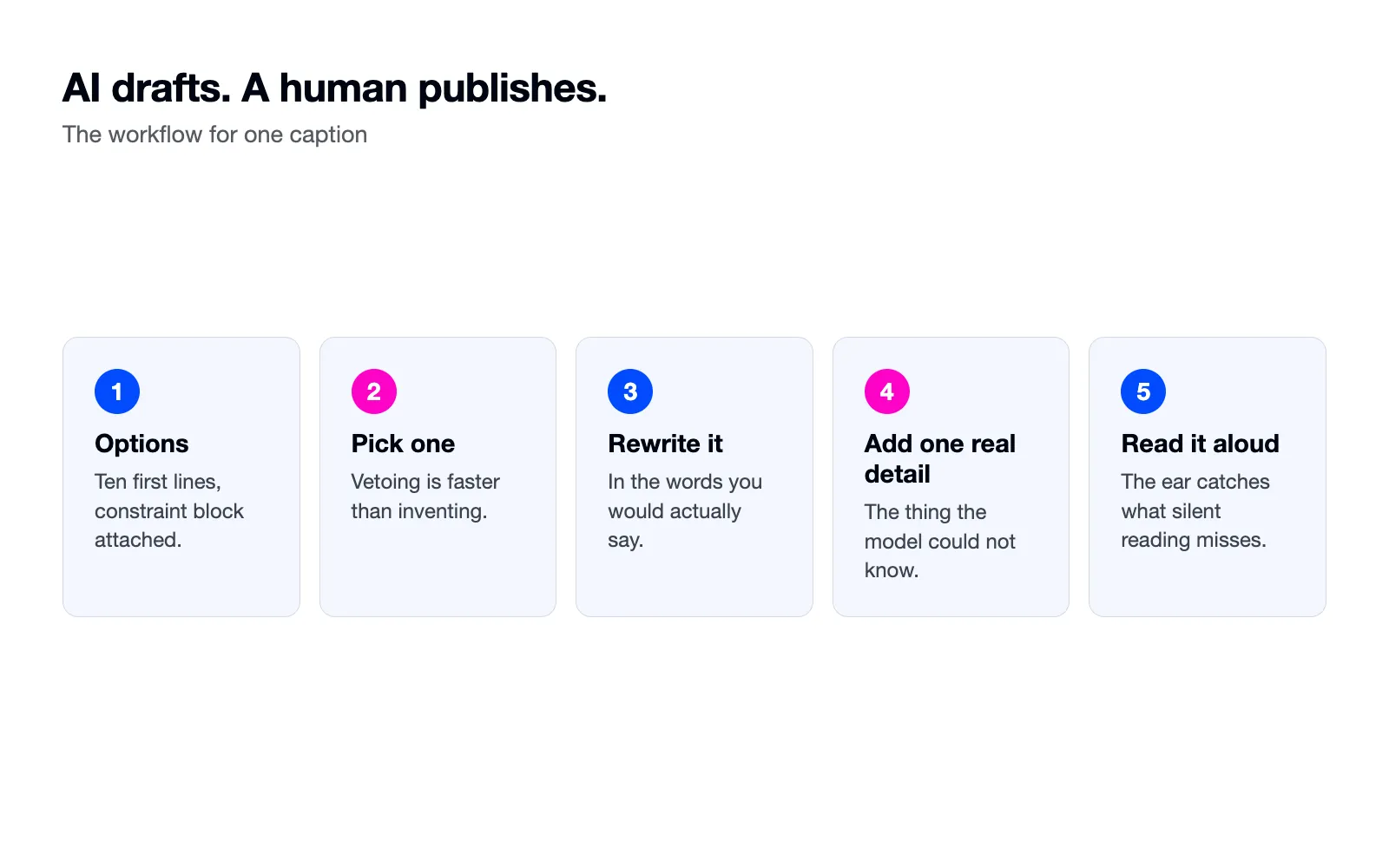
Our bet, from doing exactly this: the drafting time halves, the captions sound more like you than they did before, and the constraint list becomes the most valuable text file you own.

Georgia May
CEO & Founder of Tea & Toast