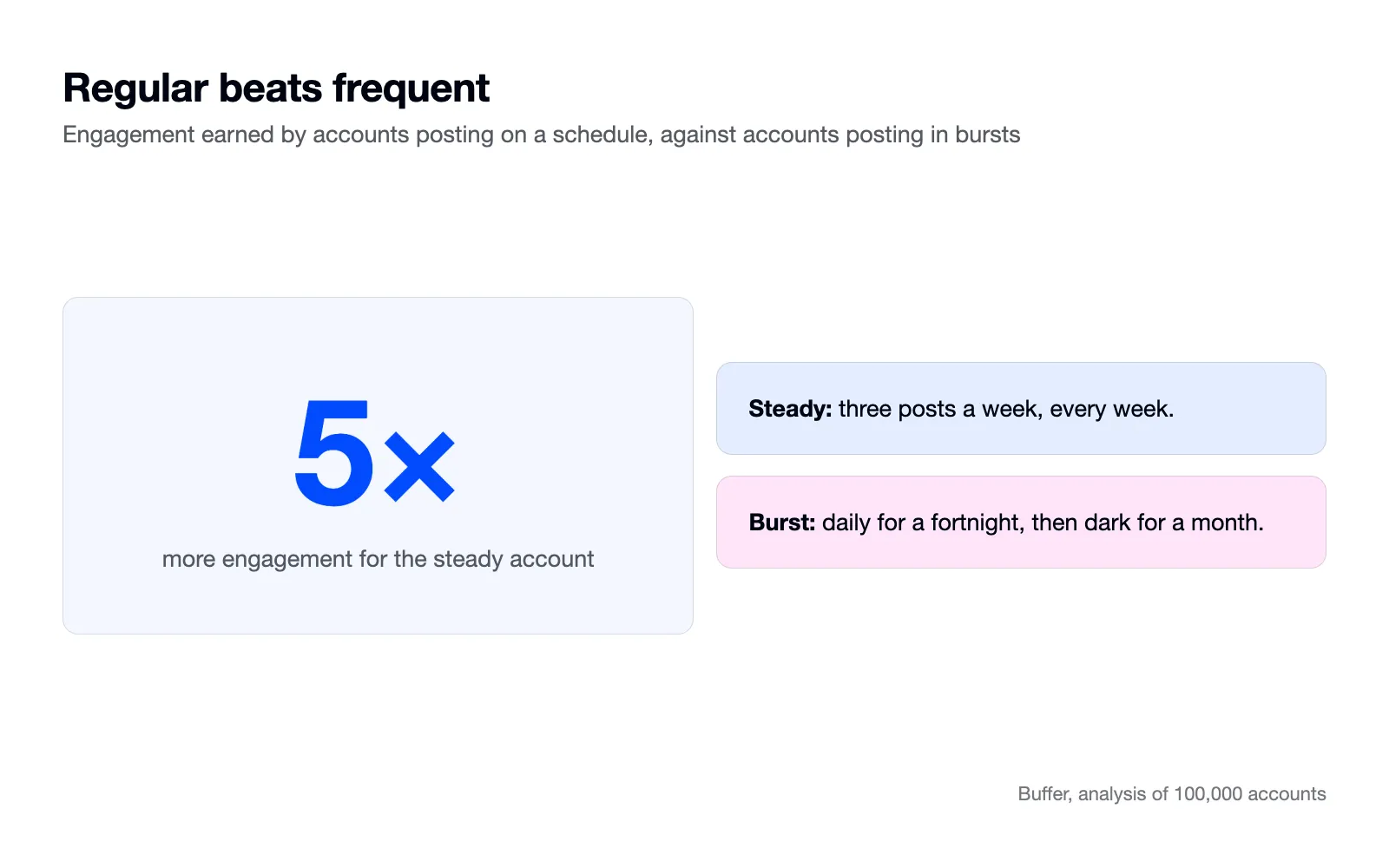
Three to five posts a week on Instagram, and fewer than you think everywhere else. That is Buffer's 2026 recommendation, and the data behind it is blunt: across 100,000 accounts they analyzed, the ones posting on a regular schedule earned five times the engagement of the ones posting in bursts.
Notice what that finding rewards. Not volume. Rhythm. The feed treats a steady account as a habit worth serving and a sporadic one as a gamble, so the first question is not how often you should post. It is what schedule your worst week can survive.
The cadence by platform
Buffer's 2026 frequency guide gives per-platform ranges: one to two posts a day on Facebook, three to five a week on Instagram, two to five a week on TikTok, two to five a week on LinkedIn, three to four posts a day on X, and one video a week on YouTube. Pinterest is its own animal at fifteen or more pins a day, most of them saves rather than original work.
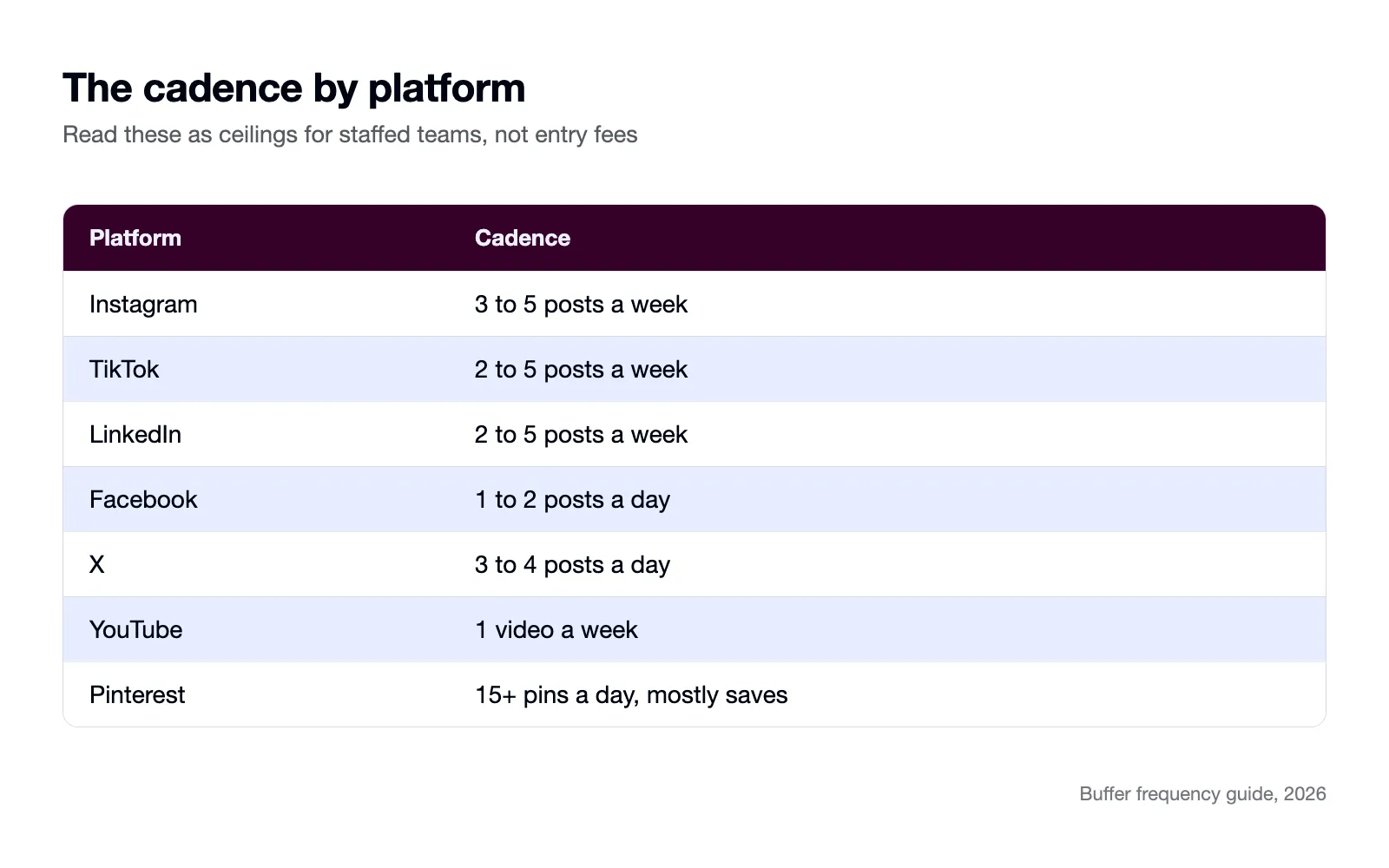
Read those as ceilings for staffed teams, not entry fees. A small business that tries to hit every ceiling on every platform will produce thin content everywhere and durable content nowhere. Two platforms served properly beat six served with leftovers.
Pick the two where your customers already are. For most local and product businesses right now that is Instagram plus one other, and the other depends on what you sell and who buys it.
Why a steady schedule wins
Two mechanisms do the work. The first is the algorithm: consistent accounts give the feed a reliable supply of fresh content, and the feed responds by keeping them in rotation. Buffer's five-to-one finding is that mechanism measured.
The second is your audience. People build viewing habits around accounts that show up on a rhythm, the same way they build habits around a weekly show. An account that vanishes for three weeks breaks the habit, and the algorithm registers the broken habit as falling interest.
Posting more will not save you. Socialinsider's 2026 benchmarks found brands posted 35% more Reels year over year while Reels reach fell 35%. Everyone posting more is why everyone reaches less. You cannot win that race by joining it. You win by keeping a schedule while everyone else burns out.
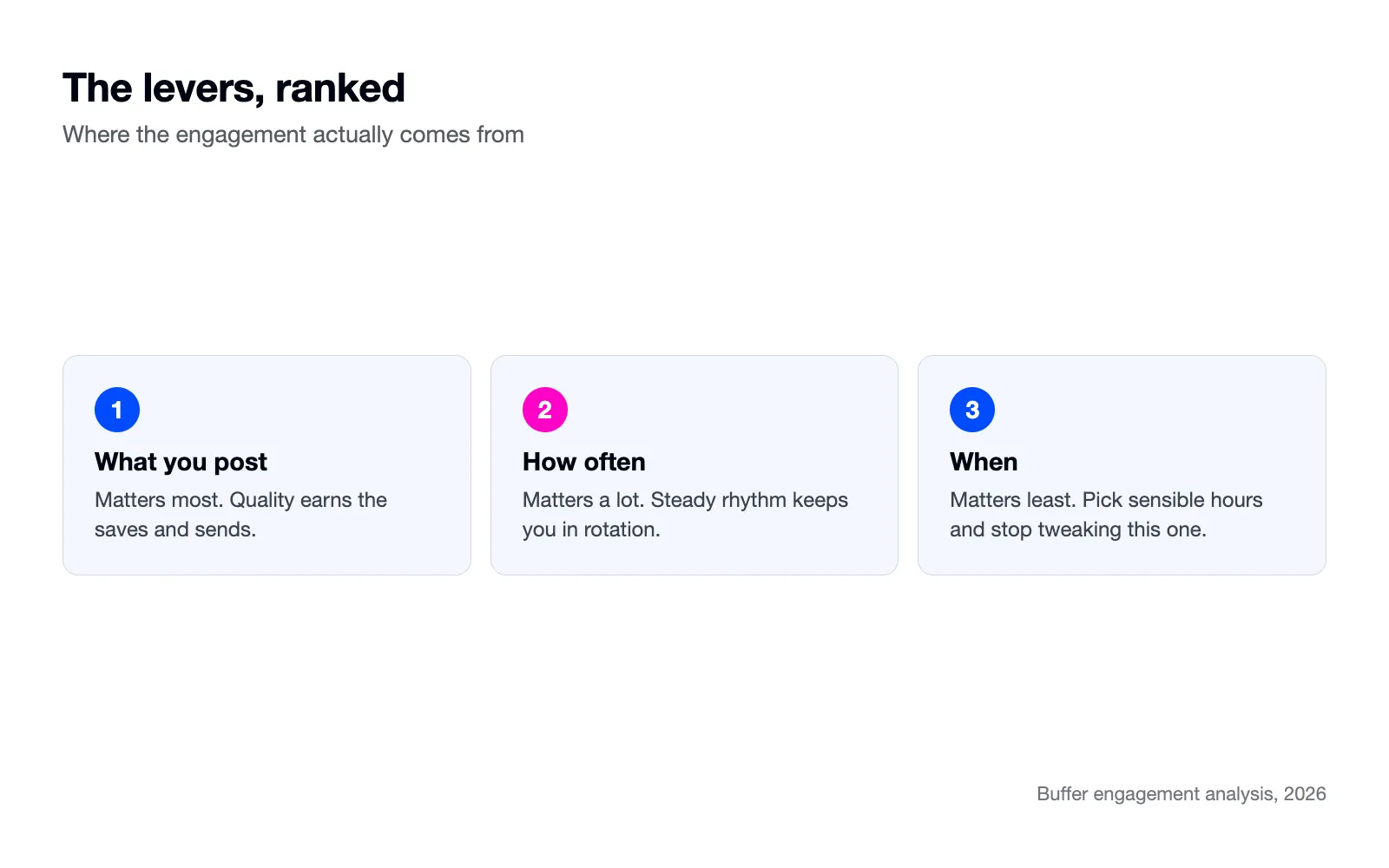
And before you ask about posting times: Buffer's analysis ranks the levers plainly. What you post matters most, how often matters a lot, when matters least. Pick sensible hours and put the energy into the posts.
Find your real number
Start from the time you actually have, not from the number you wish you could hit. Time one post honestly, from idea to published: the filming, the editing, the caption, the uploading. For most small teams that is one to two hours once you stop pretending it is twenty minutes.
Now look at your actual week and find the hours that exist even when the week goes wrong. If four honest hours exist, you have two to three posts. That is your number, and it is a good number. Buffer's data says the account that holds three a week beats the account that swings between seven and zero.
One more filter: every post has to clear your quality floor. A post you would not show a customer across the counter teaches the feed to skip you. When capacity and quality argue, quality wins and the number drops.
Make the number cheaper with repurposing
One idea should rarely be one post. A sixty-second video of you fixing a common mistake is also a carousel of its five steps, a single image of the before and after, and a text post of the one-line lesson. Same idea, four slots, one filming session.
This is how a two-person operation hits three posts a week without a content treadmill. Plan ideas, not posts: a month needs four to six good ideas rather than twelve separate ones. Repurposing also repeats your message to the people the feed skipped the first time, which is most of them.
Batch a month in one sitting
The schedule survives on batching. Planning twelve posts takes one sitting at the start of the month. Filming them takes one block, because setup and teardown are the expensive part and you pay them once instead of twelve times. Captions take another block. Scheduling takes minutes, and every major platform now has a native scheduler, so this costs nothing.
Give the twelve posts jobs before you make them. A month at three a week might carry four posts that answer a question customers actually ask, four that show the work or the product, two that share a number or a result, and two that are simply human, the shop dog included. Jobs first, ideas second: it kills the blank page and keeps the month from becoming twelve versions of the same post.
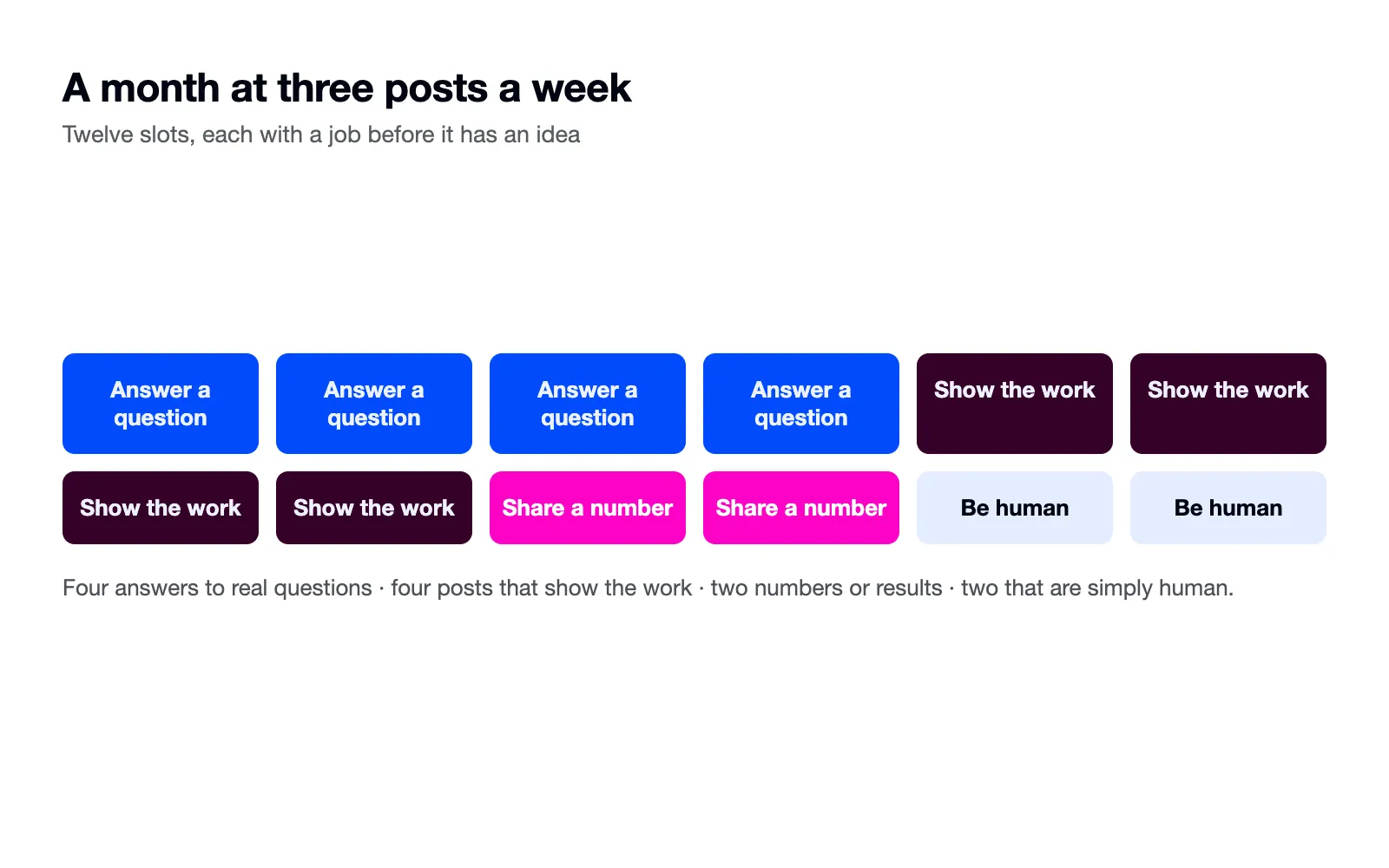
Batching also protects the bad week. When the fridge dies and the staff member calls in sick, the posts are already made, and the rhythm holds. That is the whole point of a calendar somebody actually keeps.
Plan the season, not just the month
Seasonal content only works if you start it early. Content for a December push gets planned in September and made in October, because November is when you are busy selling. Content planning research keeps landing on the same rule: start the calendar work three months out, whatever the season.
Keep the split visible in the calendar: evergreen posts that work any week, seasonal posts with a date on them, and deliberate gaps left open for reacting to whatever the month brings. A calendar with no gaps is the other way calendars die, because real weeks contain surprises and a full grid has nowhere to put them.
When you miss a week
You will miss a week. The fix is to go back to the schedule, not to make up the missed posts. Posting six times to make up for a silent fortnight recreates the burst pattern the data punishes, and your audience experiences it as noise. Skip the catch-up burst, restart the schedule, and the gap stops mattering within a few steady weeks.
Stories don't count toward the number
The cadence above counts feed posts, and Stories sit outside it. A Story is cheap, disappears in a day, and reaches the people who already follow you, so it needs neither the calendar nor the quality floor. Use Stories for the running commentary: the restock, the queue out the door, the behind-the-counter moment, as often as feels natural. The feed builds reach with strangers, the Stories keep the regulars warm, and neither substitutes for the other.
That split also settles the guilt. A day with three Stories and no post is not a posting day, and a quiet Stories week does not break your streak. Judge the schedule on the feed alone.
Hold it for four weeks, then judge
Whatever number you pick, hold it for four weeks and change nothing else. Measure engagement as interactions divided by reach at the start and the end. Four weeks is long enough for the feed and your audience to register the rhythm, and short enough to stay honest.
If the number held and the week never buckled, consider adding one post a week. If you missed slots, drop one instead. The schedule you can keep is the one that works.
Cadence is one of the first things we look at in our audit, because it is the cheapest fix with the largest effect. If you want your calendar checked against your capacity by someone outside it, that is what the audit is for.

Georgia May
CEO & Founder of Tea & Toast